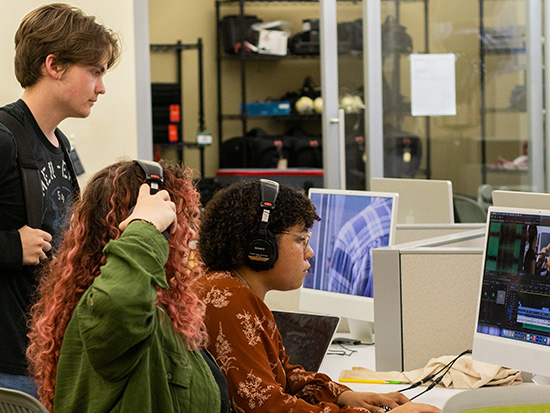
During Fall 2004, the Knowledge Discovery and Data Mining Research Lab (KDDM) at CIS UAB, led by Dr. Alan Sprague and Dr. Chengcui Zhang, was established in order to support research of new algorithms, systems, and applications for large-scale data mining and visualization. The research combines development of pattern matching algorithms, statistical techniques, distributed database techniques, and visualization methods. It hosts faculty, students, and visiting scholars, conducting cross-disciplinary research as well as developing test beds.

Our current research activities focus on the following areas:

  • Event sequence data mining
  • Multimedia data mining, in particular images and videos
  • Spatio-temporal data mining (e.g., traffic surveillance data)
  • Meta-learning for model selection and combination
  • Incremental learning, i.e., adapting to new data without retraining
  • Distributed data mining for large scale scientific data using grid computing
  • Data mining for Biomedical Informatics
  • Computer Forensics

We have applied research to several domains, with close collaboration with colleagues in Civil Engineering, Pathology and Medical Informatics, and Geology, as well as education. The methods and tools have so far been applied to healthcare applications, traffic surveillance applications, image analysis and retrieval, and the identification of events of interest for sports videos. More recently, our research areas have been expanded to include bioinformatics applications. Some highlight systems include automatic indexing and summarization for soccer videos, automatic vehicle identification and tracking for Intelligent Transportation Systems, and a tool called Data Mining Surveillance (DMSS) which searches temporally organized medical data, builds associations and applies interesting heuristics for medical domain experts.

This newly established KDDM lab principally houses six DELL high-performance OptiPlex TM GX280 desktops (Pentium 4 3.2GHz, 1.0GB SDRAM, ATI Radeon X300 video card) for the data mining graduate students. In Spring 2005, the new lab purchased a data storage-centric computer cluster of 11 nodes (1 master node and 10 client nodes), which are connected by high-speed Ethernet switch. This cluster will be used to support our research in parallel data mining on a large scale of data in a distributed environment. The research of KDDM faculty and students is supported in part by National Science Foundation (NSF) and IBM.


Knowledge Discovery and Data Mining Laboratory
Computer and Information Sciences at UAB.