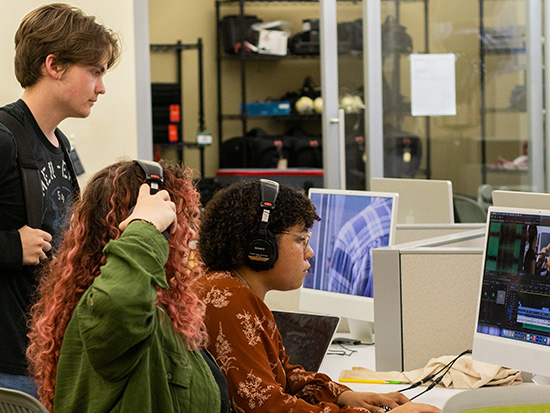
The Department of Computer and Information Sciences (CIS) is housed within the College of Arts and Sciences (CAS). Our undergraduate program offers a Bachelor of Science degree. The undergraduate UAB Computer and Information Sciences degree is accredited by the Computing Accreditation Commission of ABET, www.abet.org. Additionally, the BS in Computer and Information Sciences offers the opportunity to minor in another discipline as well as co-op programs with local industry.
CIS offers high quality programs of study leading to MS and PhD degrees in Computer and Information Sciences, as well as an inter-disciplinary Bioinformatics program. Additionally, CIS offers a shared-MS degree program with Justice Sciences and the UAB School of Business in Computer Forensics and Security Management (MS-CFSM).
CIS research is funded by the National Science Foundation, the Office of Naval Research and the National Institutes of Health, the Defense Advanced Projects Agency, the Department of Homeland Security, among others. The department hosts a seminar series and has an active student ACM chapter.
Vision
The Computer and Information Sciences mission is excellence in teaching, research, and service that advances the UAB mission, while serving its students, community, state, region, and nation. Our graduates bring technical, ethical, and life-long learning skills to Computer and Information Science careers.
Mission
The Mission of the CIS Program is as follows:
- To provide quality instruction to all our students
- To carry out relevant research, frequently in collaboration with other disciplines
- To provide service activities to the university community, computer professionals in the community as well as society as a whole.
Degree Programs
The Bachelor of Science in Computer and Information Sciences promotes an appreciation of both theoretical and applied topics within the context of computational thinking, through quality instruction in the classroom and laboratory. The Bachelor of Science degree prepares individuals for careers in theoretical or applied computer and computational sciences, software engineering and commercial software development, and science-related professions.
The Master's degree in Computer and Information Sciences provides an extra level of knowledge, complementing the foundation provided by the Bachelor of Science Degree. It also helps many students with undergraduate degrees in closely related disciplines, such as in mathematics or engineering, to make a transition to a deep knowledge of Computer Science. Students with the MS degree go on to solve computational problems in the sciences and engineering, while bringing a deeper, broader perspective to such problems than students prepared at the Bachelor of Science level.
The Master's degree in Computer Forensics and Security Management provides an interdisciplinary degree program emphasizing key theory, practice, and foundations from computing, justice sciences, and business to address current and emerging topics in computer security, digital forensics, and cyber crime. This degree helps students seeking analyst roles in industry and government prepare to fill crucial gaps in the Nation's capacity for critical infrastructure protection, privacy, identity, and the safety of e-commerce. Students with the MS-CFSM degree go on to solve problems such as tracking criminals to e-mail crime, identifying malware provenance and attack vectors in computer systems, and working specific criminal investigations where computers, networks, and or e-commerce are involved.
The Doctor of Philosophy degree in Computer and Information Sciences (PhD) prepares graduates for life-long careers in scientific inquiry, as well as ability to work in industry where rapidly evolving computer and information sciences drives the 21st Century world economy. PhD graduates provide the greatest impact on the search program of CIS, as well as the community by providing researchers, teachers and scholars in the community, state, region, and nationally. Students completing the PhD go on to solve problems such as new ways to mine "big data" from the Internet, solve problems in cyber crime, create innovative visualization and graphics solutions, advance the use of modern IT infrastructure such as cloud computing, and pursue inquiries at the frontiers of computer science understanding.
Bachelor of Science Educational Objectives
The educational objectives of the Bachelor of Science in Computer and Information Sciences degree are to prepare qualified graduates who will be successful in the computing profession or in graduate school, and gain the following abilities within a few years of graduation from our program:
- Continue routinely to acquire and apply Computer Science techniques and skills to solve practical and real-world problems of value to their employers/customers
- Learn to become excellent team members, communicate effectively, and work with others from diverse backgrounds
- Grow their understanding of professional and ethical responsibilities in the daily and evolving practice of their profession